
March 28, 1931 – July 18, 2026
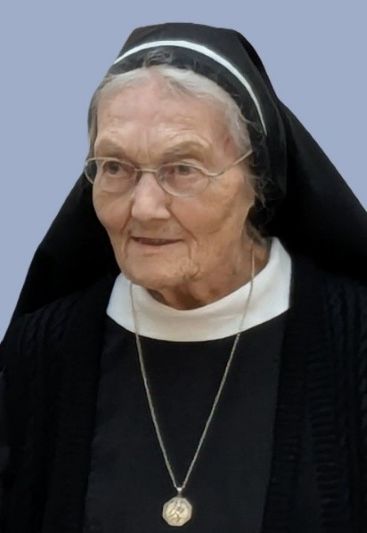
Maria Schnatterbeck was born in Baranja Kisfalud, Yugoslavia, on March 28, 1931. Her parents, Adam and Katharina Schnatterbeck (née Emling), were farmers. She had one brother. She attended elementary school in Kisfalud until the 9th grade. In 1944, her family was evacuated from the front lines and arrived in Styria. They stayed there for three months, then continued on to Silesia. Many more stops followed until the end of the war in 1945 – a restless life as refugees, as experienced by many thousands at that time. After the end of the war, they tried to return to their homeland in Yugoslavia. However, they were unable to make it through, as they were captured and imprisoned in Hungary.
She wrote in her autobiography: “We were close to starvation when, having been completely stripped of our belongings, we were handed over to Austria. Since Austria was flooded with displaced persons at that time and the country itself was completely ruined by the war, we wandered through many regions until we finally found a second home in Gerhaus, Lower Austria, in 1947. We were taken in as farm laborers on a country estate. I worked there for 14 years, then developed a lung disease and had to take a two-year break. I made a full recovery at a sanatorium for lung diseases.”
She then changed jobs and became a housekeeper for two elderly ladies in Bruck/Leitha. Both women were patients of Sr. M. Oswina Öttl. Sr. Oswina visited them every day, and so Maria Schnatterbeck was able to get to know the Congregation of the Sisters of the Sorrowful Mother. After the death of these two women, she entered the Sisters of the Sorrowful Mother in Vienna-Simmering on April 14, 1967.
After her postulancy, she received the habit on January 6, 1968, and chose the name Maria Martina of St. Barbara. She made her first vows on August 12, 1970, in Vienna; on August 11, 1976, she made her perpetual vows; in September 1995, she celebrated her silver jubilee; and on September 20, 2020, her golden jubilee. Her ministry was in the kitchen and in housekeeping. Afterwards, she worked as a kindergarten assistant at the branch Höfleinerstraße in Bruck/Leitha. In 1977, Sr. Martina also obtained her driver’s license so she could drive regularly to Wilfleinsdorf to care for the sick there.
From April 1, 1974, to May 28, 1975, she took a course in geriatric care. She then worked at the Himberg nursing home for the elderly until the order’s newly built facility opened in 1979/1980. She then moved to the Marienheim to work in the nursing ward.
In 1986, she moved to the sisters’ community at Höfleinerstraße 16. There, she served as local superior from 1990 to 1991 but continued to work in the nursing ward.
When the building on Höfleinerstraße was sold in 1994, all the sisters moved to the Marienheim. She worked there for many years: first in nursing, and later, as her strength diminished, she distributed yogurt and fruit to the residents in the mornings and helped them wherever needed. For some of the residents, she put their washed laundry away in their drawers.
Sr. Martina was a good and empathetic listener. Shaped by her own experience as a refugee, she had a special sensitivity toward people suffering. She loved nature deeply, was extremely interested in biology, and followed the destruction of the environment with great vigilance and growing concern. Almost every day after work, she would take a long walk. She also enjoyed riding her bike. She was a quiet and diligent worker and a prayerful person: the Rosary was important to her, and she wrote many short prayers on little slips of paper.
For her we hope with full confidence that she is now personally experiencing the promise of the Gospel: “You have been faithful in a few things; I will put you in charge of many things. Come, share in the joy of your Lord!” (Mt 25:21)
Submitted by Sr. Gudrun Schellner